Communication Breakdowns: The Foundation of Airway Safety
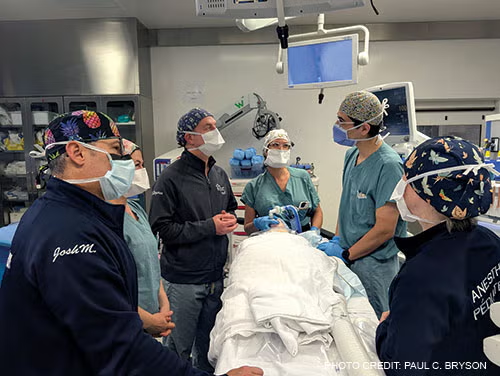
Effective management of difficult airways hinges on seamless communication among a multidisciplinary team. Paul C. Bryson, MD, director of the Cleveland Clinic Voice Center and section head of laryngology in Ohio, emphasizes that failure to share critical patient history, such as a previous challenging intubation, with anesthesia colleagues represents a significant missed opportunity for preparedness. "These exams provide incredibly useful conversation points in terms of what the upper airway looks like before you initiate airway care," Dr. Bryson stated. "They don’t prevent or fix every difficulty, but you will be far better prepared when a routine case deteriorates, and emergency interventions are needed."
This proactive communication extends to leveraging advanced imaging and collaborative expertise. Pre-procedure CT scans and video laryngoscopy are invaluable tools for visualizing key anatomical structures, offering crucial insights that can inform the surgical plan. Dr. Bryson also stresses the importance of engaging the full spectrum of airway specialists, noting that managing a difficult airway is a "team sport." At Cleveland Clinic, this includes close collaboration with interventional pulmonologists for their expertise in rigid bronchoscopy, underscoring the role of the ENT airway specialist as a "coach" responsible for assembling the right team.
Mathieu Bergeron, MD, FRCSC, a pediatric otolaryngologist at CHU Sainte-Justine Hospital in Montreal, echoes this sentiment, routinely reviewing complex airway case details with nursing, anesthesia, ENT, and OR technicians. "I often say the best airway rescue is the one that you never have to use because you anticipated the problems before even starting the case," he explained. This philosophy drives the daily focused ENT/anesthesia airway huddles implemented by Taher Valika, MD, medical director of the aerodigestive program at Ann & Robert H. Lurie Children’s Hospital of Chicago. These huddles meticulously review potential intubation difficulties, necessary equipment, and the safest ventilation strategies, ensuring a comprehensive pre-operative plan.
Underestimating Pediatric Airway Fragility
A recurring theme among experts is the critical need to avoid underestimating the inherent fragility of pediatric airways. Dr. Valika warns that children with difficult airways can present deceptively stable, with a limited margin for error that can lead to sudden decompensation. He recounted a case at Lurie Children’s where a child initially appearing to hum was found to have biphasic stridor, indicating a "pinpoint airway" that rendered him unable to go home safely. This experience served as a stark reminder that severe airway obstruction can be "deceptively subtle," with children often compensating until their airway capacity is completely exhausted. This highlights a significant challenge: the rapid and often unpredictable deterioration of pediatric respiratory function, a factor that must be a cornerstone of any pre-operative assessment and emergency preparedness plan.
The Perilous Landscape of Pre-existing Conditions
Pre-existing medical conditions can transform a standard procedure into a complex airway challenge. Jonathan M. Bock, MD, FACS, a professor at the Medical College of Wisconsin, points to cancer patients with airway fibrosis from radiation therapy as a particular concern. His meticulous approach involves probing the airway with a large-bore IV catheter and saline to "dissect down to the airway to localize it even in a bed of scar tissue."
Congenital disorders also present formidable obstacles, especially in pediatric patients. Dr. Bergeron highlights children with complete tracheal rings (CTR) as an example of an "unforgiving" airway where even minor swelling or secretions can lead to rapid obstruction, precluding safe intubation. He has witnessed teams repeatedly attempting intubation in such cases, exacerbating edema. More effective strategies, he notes, include using heliox, a lighter breathing gas mixture that reduces turbulence in narrowed airways, or, in severe cases, extracorporeal membrane oxygenation (ECMO).
Tyler Crosby, MD, from the University of California, San Francisco, cautions that congenital airway anomalies, such as micrognathia and macroglossia, can persist into adulthood, complicating both mask ventilation and tracheal intubation. These patients often exhibit hypotonia and do not emerge from anesthesia as smoothly, presenting a persistent challenge for adult ENT specialists. The long-term implications of these congenital conditions underscore the necessity for lifelong vigilance and specialized care pathways.

The Tracheostomy Dilemma: Embracing Surgical Airway Management
Dr. Bryson advocates for a more proactive approach to tracheostomies, becoming increasingly willing to recommend them for patients with difficult airways to ensure safety. This strategy is particularly beneficial for patients with airway scarring, bilateral vocal cord paralysis, or multi-level airway obstruction. "We can still meet their functional needs—they can still work and live with the tracheostomy," he explained, adding that it can be a "lifesaving" measure for patients living far from specialized centers.
A related pitfall, according to Dr. Bock, is the reluctance of some otolaryngologists to be involved in the long-term care of tracheostomy patients. "As otolaryngologists, we are masters of the upper airway," he asserts, arguing that this expertise comes with a responsibility to provide comprehensive management. He encourages colleagues to view these requests not as a burden but as a testament to their specialized knowledge. This perspective is crucial for establishing robust continuity of care, ensuring that patients with surgical airways receive ongoing expert management.
The Underestimated Power of Awake Intubation
Awake intubation, performed with minimal sedation, is an effective but sometimes underutilized strategy for managing difficult airways. Dr. Bock emphasizes that a patient’s own respiratory drive can be the critical factor in preventing rapid decline. Guidelines from the Difficult Airway Society support awake tracheal intubation in adults for preserving spontaneous ventilation and airway tone, maintaining patient cooperation and protective reflexes.
Dr. Bryson concurs, citing cases involving upper airway tumors, obstructions, or post-radiation changes where awake intubation allows for navigation around challenging anatomy, avoiding the potential for excessive upper airway relaxation and subsequent obstruction that can occur under anesthesia. This technique is particularly valuable in high-risk scenarios where maintaining patient control is paramount.
The Criticality of Early ENT Consultation
A significant pitfall identified by multiple surgeons is the delay in involving ENT specialists in complex airway cases. Dr. Bryson notes that ENT teams are often called in as a "surgical airway team of last resort" when a patient is already in critical condition. A more effective approach, he insists, is to "bring us in early so we can help with a more thorough assessment and anticipate and avoid problems before they occur."
Dr. Crosby recounts a case where his team received a late "heads-up" call about a cancer patient scheduled for sedation. Upon examination, the patient’s neck was severely indurated from radiation, with no palpable landmarks. Dr. Crosby’s team immediately advised against the procedure, highlighting the extreme difficulty of managing an emergent surgical airway in such a compromised state, even with prior knowledge. He criticizes the notion that ENT is "just down the hall" and can "save the day" as an inadequate management plan, underscoring the need for early, proactive consultation.
Empowering Junior Clinicians: Trusting Residents
Dr. Bock addresses a related handoff issue concerning awake intubations. He observes that while anesthesiology staff may perform these procedures infrequently, ENT residents often gain extensive experience through daily clinic work. He has witnessed instances where residents offering assistance during airway emergencies are sidelined, only for them to successfully secure the airway when given the opportunity. This underscores the importance of respecting and relying on the expertise of residents, ensuring they are integral members of the airway management team.
Meticulous Equipment Planning: Preventing Long-Term Sequelae
The selection of the correct endotracheal tube size is paramount to preventing serious long-term sequelae. Dr. Crosby highlights cases of severe laryngeal injuries and stenosis resulting from the use of inappropriately sized tubes, leading to the lifelong need for tracheostomies. He dispels the myth that larger tubes are always necessary for morbidly obese patients, explaining that airway size is determined by height, not weight. He has treated patients who were intubated with tubes two sizes too large due to their weight, resulting in significant airway complications.

At Lurie Children’s, the Rapid Difficult Airway Response (RaDAR) team, supported by a dedicated instrument cart, ensures that specialized personnel and essential pediatric airway equipment are readily available. These carts provide responders with critical tools, including flexible bronchoscopes and pediatric tracheostomy trays, enabling swift and effective intervention. The RaDAR team’s composition—including anesthesia, ENT, and a technician—ensures that expertise and equipment arrive simultaneously.
Dr. Bergeron learned the hard lesson of inadequate equipment planning when a pediatric case required a size three tracheostomy tube, but a size five was provided. This experience reinforced his commitment to meticulous equipment checks and planning. He advocates for video laryngoscopes or rigid endoscopes like the Hopkins rod, which provide direct visualization of tube placement and can serve as "lifesavers."
Dr. Crosby emphasizes the importance of familiarity with available airway equipment, its location, and setup. He advises mentally rehearsing the surgical plan and contingencies, ensuring all necessary equipment is present and functional before the patient enters the operating room. The absence of crucial items like a functioning light source or suction, or the unavailability of a dilator, can be catastrophic in time-critical situations. He also acknowledges that "high acuity, low frequency" airway cases often necessitate working with teams less experienced in specific procedures or equipment, making the minimization of chance and guesswork critical.
The Peril of Inadequate Pre-Transfer Airway Assessment
Dr. Crosby expresses concern over patients being transferred for ENT management without a thorough airway assessment. He cautions against the assumption that a stable appearance and acceptable oxygen saturation guarantee safety during transfer. A "foundational airway assessment," even a simple bedside flexible scope examination, is crucial for gathering valuable pre-transfer information. This ensures that the receiving team has a clear understanding of the patient’s airway status and can plan accordingly.
The Subtle Impact of Patient Positioning
Poor patient positioning, even among experienced teams, can be a significant pitfall. Dr. Bock observes anesthesiologists attempting emergency intubations with patients lying flat. He advocates for positioning patients forward, similar to how they are assessed in clinic, to achieve better visualization of the airway. This simple adjustment, he notes, "makes a huge difference when viewing the airway" and is a fundamental teaching point for trainees.
Enhancing Airway Management Through Training and Education
The commitment to robust training and education is paramount for effective difficult airway management. The Chicago Advanced Airway Course, presented annually by Dr. Valika and his colleagues, brings together multidisciplinary teams of trainees and faculty for hands-on simulation and emergency scenario practice. These courses deliberately model high-stress, worst-case scenarios to prepare participants for the rapid and often chaotic nature of real-life emergencies.
Dr. Bock’s "ENT! 911!" lecture series aims to equip the next generation of ENT surgeons with the skills and mental fortitude required for emergency airway cases. He emphasizes the importance of mental preparation, encouraging trainees to approach critical situations with a calm demeanor, viewing themselves as one component of a larger surgical team rather than solely responsible for the outcome. This psychological framing helps mitigate the overwhelming pressure of life-or-death scenarios.
The insights from these experienced ENT surgeons underscore a universal truth: proactive communication, meticulous preparation, and continuous education are the cornerstones of successful difficult airway management. By heeding these warnings and embracing best practices, healthcare teams can significantly reduce the incidence of these perilous pitfalls and ultimately improve patient outcomes.